Biodiversity
We are committed to operating our business with consideration for the conservation and restoration of biodiversity, in pursuit of a society that coexists with nature.
This approach is aligned with our management philosophy and sustainability vision. Alongside addressing climate change and promoting resource circulation - our most material issues - we also regard biodiversity as a critical theme requiring further action.
Our business depends on ecosystem services such as the procurement of raw materials and water supply, while also generating environmental impacts - including greenhouse gas emissions, water use, and waste - that may alter natural systems. We recognize these as sources of both risks and opportunities related to nature in our business operations.
For example, cooling water used in the glass melting process is drawn from and discharged back into the natural environment, which may have potential impacts on the ecosystem. Furthermore, we rely on nature for the supply of silica sand and soda ash, the raw materials for glass, as well as the fuel required for glass melting. Additionally, biofuels may become increasingly important in our decarbonization roadmap going forward.
Conversely, we offer products that prevent bird strikes (Pilkington AviSafe™), and providing such products that contribute to biodiversity conservation presents opportunities for our Group.
In line with the TNFD framework, we conducted an assessment of our business’s dependencies on ecosystems and the impacts our business activities have on ecosystems. As this is our first year of disclosure, we adopted a pilot approach, placing emphasis on understanding the current state and conducting foundational analyses. Over the coming years, we plan to publish a preliminary report first, followed by a report covering our global operations.
TNFD-Aligned Disclosure
Going forward, we will continue to reassess our relationship with nature across all aspects of our corporate activities - from raw material sourcing, manufacturing, and product delivery to green space management at our sites and collaboration with local communities - as we work toward a nature-positive future.
Products and Biodiversity Conservation
NSG Group is engaged in developing products that contribute to the conservation of biodiversity.
Pilkington AviSafe™, developed at our UK site, is a specially coated glass designed to reduce the risk of bird collisions. It features UV patterns that are visible to birds but virtually invisible to humans, enabling biodiversity conservation without compromising the aesthetics or transparency of buildings.
As regulations requiring the use of bird-friendly glass are advancing in the United States and other regions, this product offers a competitive solution that meets both regulatory requirements and environmental considerations in the architectural market. By combining with other glass products offering insulation and acoustic performance, additional value can be created. Through addressing environmental challenges, we aim to enhance customer trust, increase brand value, and expand revenue opportunities that contribute to sustainable growth. For more information, please refer to our business overview.
Conservation Activities at Our Sites
- Ecosystem Survey at the Maizuru site in Japan
The Maizuru site, located in Japan, is NSG Group's largest manufacturing site in the country and values its strong ties with the local community. At NSG, we believe that understanding the impact of land use from our business activities on local ecosystems is essential to promoting biodiversity conservation. Based on this belief, we conducted an ecosystem survey within the plant premises, in collaboration with the Kyoto Prefectural and Maizuru City governments, and with support from a local environmental citizen group. As a result of the survey, the presence of species such as the osprey (Near Threatened, NT), which is classified as a threatened species, as well as the Japanese red fox and the Japanese rat snake, both listed as "species of special concern" in the Kyoto Prefecture Red Data Book, was confirmed. Going forward, we will actively promote conservation measures that are in harmony with the local biodiversity, aiming to coexist with these valuable species.
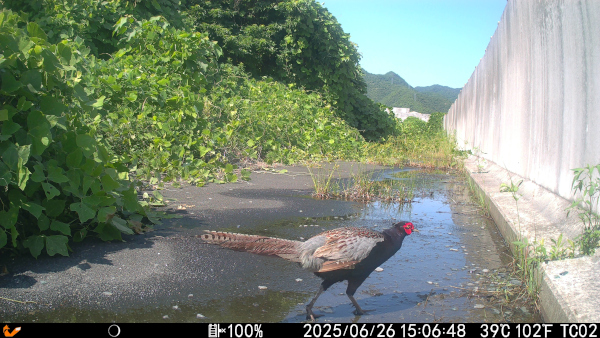
A Japanese Green Pheasant captured by an infrared camera installed on the premises of the Maizuru site
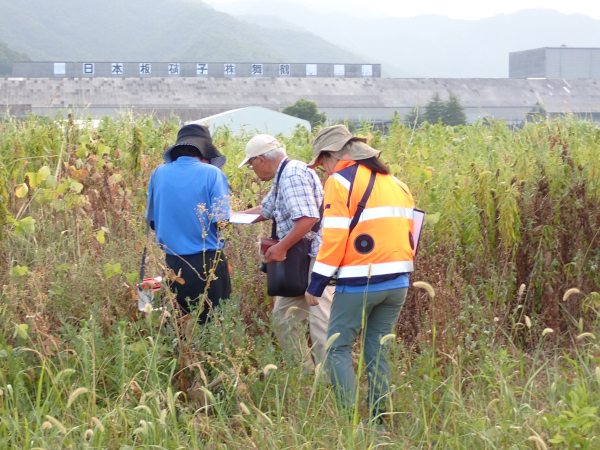
Biodiversity survey at the Maizuru site conducted in collaboration with local experts and employees
- Supporting Native Bees and Local Communities through Beekeeping at the Lathom Site in UK
For several years, beehives have been maintained near the Postillion Pond at our Lathom, UK site, in collaboration with Phil Reeves and the Ormskirk and Croston Beekeeping Society. These bees contribute to local biodiversity by pollinating a variety of plants and trees on-site and in the surrounding area.
The honey produced by these bees is harvested and sold in the site canteen, with all proceeds donated to Alder Hey Children's Hospital. This initiative not only supports a local charity but also helps to engage employees in biodiversity and community-focused efforts.
Amid growing concerns over the decline of honey bees in the UK and the increasing reliance on imported foreign bees, the hives at Lathom exclusively house native British honey bees. This is part of the National Bee Improvement Programme (NatBIP), an initiative led by the Bee Improvement & Bee Breeders Association (BIBBA), which aims to preserve and improve native bee populations for long-term ecological resilience.
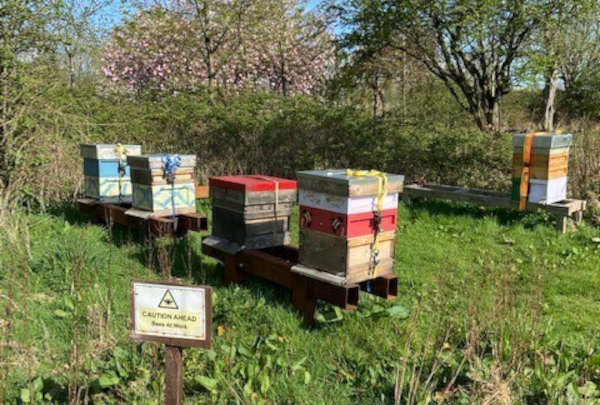
The hives at Lathom Site
- Tree Planting Activities at the Caçapava Plant in Brazil
As part of an initiative to celebrate the continuation of an accident-free period, the team at the Caçapava site began planting saplings in the green space located between two areas within the site. This small first step gradually spread to other teams and eventually developed into a site-wide project.
The activity was named "Our Greener Glass", and it is now conducted regularly with the goal of planting more than 30 saplings each month. A schedule has been set through the end of the fiscal year, ensuring that all employees have the opportunity to participate.
The tree planting is combined with eco-walks, providing employees with a chance to connect with nature and reflect on their responsibility for the future. Most recently, the team planted trees to commemorate achieving 3,500 accident-free days.
To date, approximately 300 saplings have been planted, mainly fruit trees and native species. This initiative also contributes to the restoration of biodiversity in Brazil's Atlantic Forest region.
TNFD Forum Membership
NSG Group has joined the TNFD Forum, a global stakeholder network that supports and promotes the work of the Taskforce on Nature-related Financial Disclosures (TNFD), in alignment with its mission and objectives.
The TNFD is an international initiative that supports companies and financial institutions in identifying, assessing, and appropriately disclosing risks and opportunities related to natural capital and biodiversity.
At NSG Group, we endorse the vision and mission of the TNFD and are committed to further advancing sustainability management by integrating our relationship with nature into business decision-making and corporate disclosures.
In addition, our participation in the TNFD Forum marks the starting point for a more structured approach to disclosure. Going forward, we will actively work toward implementing systematic reporting in line with the TNFD recommendations-covering governance, strategy, risk and impact management, and metrics and targets.
TNFD Forum
Free Coloring Pages Download
The NSG Group is pleased to offer original coloring pages free of charge to promote greater awareness and understanding of biodiversity conservation.
These coloring pages feature charming creatures inspired by animals living at the our Maizuru, Japan site, as well as "Robin", the character representing Pilkington AviSafe™, an innovative glass solution designed to prevent bird collisions with glass.
The content is designed to be enjoyable not only for children, but also for adults.
We hope that, by having fun, this activity will provide an opportunity to deepen interest in nature.
Download the coloring pages here (PDF)